Here's why the talk about wearables and fashion has gone very, very quiet
A sudden, striking influx of glamorous not-techies at a tech hub in California. Grumbles almost NDAs. Excited, clandestine glances. Gossip virtually disruption. A drumroll for a hitherto hush-hush, industry-upsetting declaration.
Sound familiar?
This is non a description of what happened terminal Monday at the Apple issue in Cupertino. Information technology is a description of what happened on Sep 9, 2014, when the Apple Sentry was unveiled. For those of us who remember that day, the run-up to last week has provided an eerie sense of deja vu.
Non to mention a question: What's the deal with wearables and fashion? Five years on from the watch'south much-ballyhooed introduction, is the relationship over? Has technology found a new object for its affections?
For a brief, shining moment, at that place was such an intense attraction. The trend wheel turns so fast these days that it is easy to forget, but take a moment, please, to call up when. Because it is possible that there is a lesson for usa all cached in the end of the thing (apologies to Graham Greene).
"There is this countless hunger in manner for newness and what'due south the next thing, and Apple and Silicon Valley actually promises that," said Mimma Viglezio, editor of the digital platform ShowStudio. "So they" – we! – "just embraced information technology."
The pheromones were flying
In advance of the sentinel's introduction, Apple – which, after all, had been congenital on some of the principles dearest to luxury, including the allure of tactile design, and planned obsolescence – began seducing glossy executives right and left to come work for the company.
Most notably there was Paul Deneve, chief executive of Yves Saint Laurent; Patrick Pruniaux, of Tag Heuer; and Angela Ahrendts, the chief executive credited with using technology to transform Burberry, who arrived at Apple tree to run its retail and e-tail operations with a aureate halo all the same fresh on her head.
Front-row denizens like Alexandra Shulman, editor of British Vogue, and Lauren Indvik, editor of Fashionista, flew out to Cupertino in the eye of New York Fashion Week, suggesting that when it came to shows, the 1 in California was the 1 that mattered.
During Paris Fashion Week, Apple had an unveiling at the super-boutique Colette and Karl Lagerfeld came. Later in that location was a dinner at Azzedine Alaia's, so designers like Olivier Rousteing (of Balmain) and models similar Cara Delevingne could ogle the accessory.
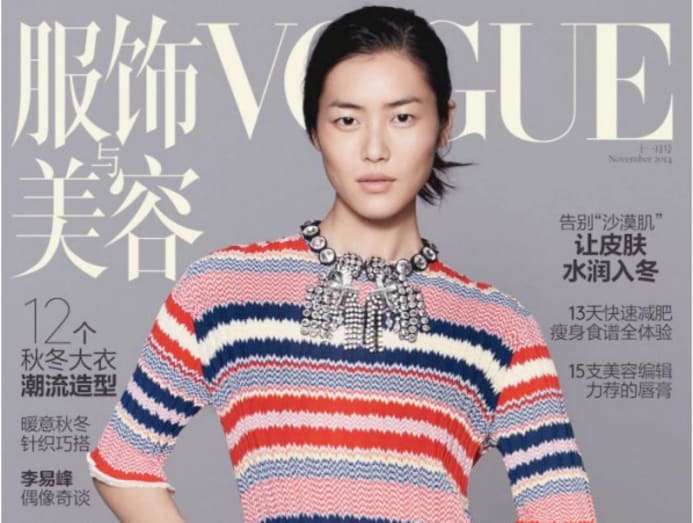
The watch made its magazine debut on the cover of China Faddy. Apple took out a 12-folio ad in American Vogue. One year afterwards the first unveil, also during fashion week, Apple appear a partnership with Hermes, and the following May the company underwrote the Met Gala for the Manus 10 Machina testify, itself an ode to the cosiness of manner and engineering science (which was the unofficial dress lawmaking of the party).
Tim Cook, chief executive of Apple, showed up; Jony Ive, Apple'due south chief blueprint officer, was a co-host, along with Anna Wintour, artistic managing director of Conde Nast and editor of Vogue. Every bit symbolism went, the picture said it all.
(Or seemed to, anyhow; whether the cosiness was part of an overall fashion strategy or just a series of coincidental niceties betwixt a visitor that makes glossy inanimate things and an industry that makes breathing things glossy, nosotros'll likely never know, given how tight-lipped Apple tree is.)
"At that place is this endless hunger in style for newness and what'due south the adjacent thing, and Apple and Silicon Valley really promises that." – Mimma Viglezio, editor of ShowStudio
In any case, Apple tree was simply a function of it.
Samsung'due south Gear Southward also made its mode week debut in September 2014, courtesy of Diesel Black Gold. Intel teamed upwards with Humberto Leon and Carol Lim of Opening Anniversary to create the MICA smartbangle. Will.i.am introduced the "puls" cuff, inspired in part by Chanel's signature Maltese cross cuffs.
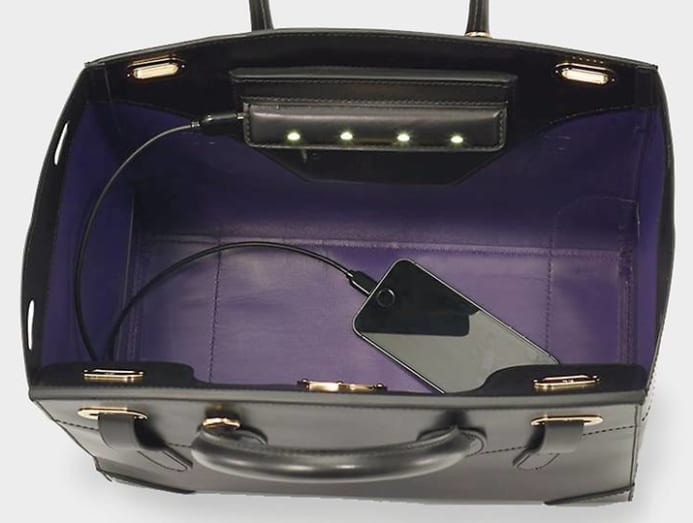
Non long afterward, Ralph Lauren introduced the connected Ricky purse with a low-cal and a charging port (which followed its connected tennis shirt that monitored heat rate). "It'southward a game changer for united states in luxury," David Lauren, the company's executive vice president for advertizing, marketing and corporate communications, said at the time.
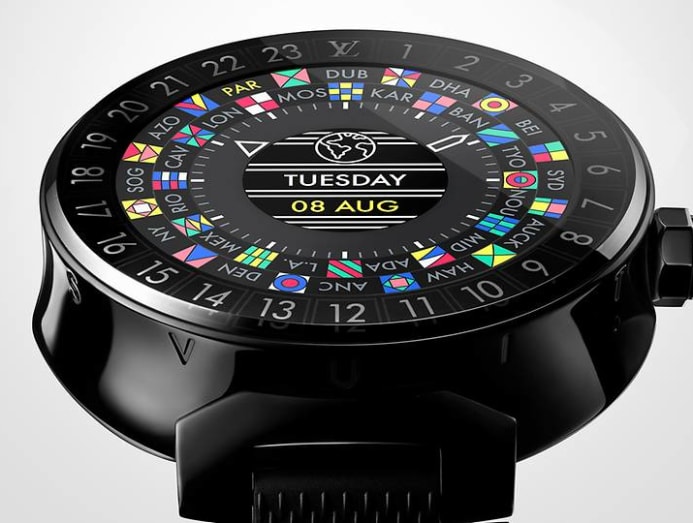
Tag Heuer, Intel and Google teamed up to brand their own connected version of the Carrera watch. Louis Vuitton made a continued Tambour Horizon and described a hereafter internet of Louis Vuitton things. It was like a smart-accessory orgy.
That moment in 2022 when Google Drinking glass strutted down the rail at a Diane von Furstenberg show and everyone cringed – even DVF could not rescue that gadget from its own nerdiness – was treated as merely an bad-mannered early on harbinger of better things to come. This was the future!
The cool of California was going to rub off on the hidebound fashion globe, and the glamour of mode was going to fill consumers with desire for products. Instead of competing for the same wallet share, they would both do good.
Trouble in paradise
But then Deneve left Apple. And then did Pruniaux. And side by side calendar month, Ahrendts departs. Intel "exited the end-product wearables area in 2017," according to a company spokeswoman, and has pivoted to data analysis used to inform retailers and brands, among others.
Volition.i.am refocused on "artificial intelligence and vocalization-controlled computing, for B2B and B2C hardware" his representative said. Ralph Lauren no longer sells a connected bag.
All the talk most wearables and way has gone very, very repose.
"The Venn overlap is not as great as anyone thought," said Scott Galloway, a professor of marketing at the New York Academy Stern School of Business and founder of the digital remember tank L2. "Engineering science is essentially most creating utility and spreading it over billions of people. Fashion is almost creating a moment, a trend, a romance and spreading it across a modest amount of influential people."
This does not mean that wearables themselves are over (although information technology would exist good if someone could call up of a unlike give-and-take for the category, since theoretically it could apply to anything you put on your body).
By all accounts, the smartwatch industry, which accounts for 44 per centum of the "clothing devices" market, according to the research group International Information Corp., is doing only fine. IDC predicts that watches will be among the primary drivers of a 15.three percent growth in the market place this twelvemonth. (A new report from the NPD group said that in 2022 sales of smartwatches in the United states of america increased 54 percent.)
In Apple'south Q1 2022 earnings call in January, Cook said its wearables category was up 50 percent (that primarily means watches and AirPods). A spokesman for Hermes said its Apple sentry was one of its most popular models. Louis Vuitton'south smartwatch accounts for half its watch business.
But while once upon a fourth dimension there were rumours about other designers joining the gang, and third parties like Coach and Kate Spade have made bands for the Apple watch, the talk these days is all well-nigh the watch beingness a platform for health and fettle – which is too why the fitness brands (Nike especially) are nevertheless gung-ho.
That does not hateful manner itself is not interested in engineering science. There is a lot of excitement amidst executives I speak to about augmented reality as a shopping tool. As far every bit material science and product, technology is hugely promising, especially as the industry looks more and more than to sustainability.
"What's happening is it has spread into the back end of product nanotechnology and cloth," said Amanda Parkes, chief innovation officer of Futurity Tech Lab. "But that takes time to develop, like biotech."
"Applied science is essentially about creating utility and spreading it over billions of people. Fashion is near creating a moment, a trend, a romance and spreading it across a small corporeality of influential people." – Scott Galloway, professor of marketing at the New York University Stern Schoolhouse of Business
In the meantime, a few brands are dallying with cool stuff on the side. Jimmy Choo recently unveiled a heated lace-upwards urban hiking boot. It warms up via a battery in the heel, and then connects to a phone app so you tin command and monitor the temperature. Ralph Lauren has designed heated versions of its Polo 11 and Olympic puffer jackets (they are likewise controlled via an app).
Vuitton introduced wireless earphones fabricated with Master & Dynamic engineering science and is testing a continued suitcase. And Levi'due south has been selling its Commuter ten Jacquard past Google continued jean jacket since autumn 2017.
Simply the fact that all of those developments, which v years ago would take been trumpeted with drumrolls and bells and whistles, slipped in practically under the radar is cogitating of the new land of ... well, I wouldn't call information technology estrangement, but rather a cooling off of the in one case heated relationship.
It's not you lot, it'southward me
"The continued boot is playful and was only one of those things we kind of add on when it makes sense," said Sandra Choi, artistic managing director of Jimmy Choo, who added that the boot has been well received. It was not included, though, in the company'south presentation during the about contempo Milan Fashion Calendar week considering it was not considered cadre to the Jimmy Choo identity, or even indicative of futurity direction.
Paul Dillinger, caput of global production innovation at Levi's, said much the aforementioned, noting that the connected jacket is positioned in Levi's Commuter Collection, "which is a adequately niche area of the business organization." When information technology came time for the side by side season'south release, instead of offering a new way or a new product, the company chose to offer the same production – with new applications.
"We put the creative energy of way blueprint into the jacket's digital collateral rather than physical collateral," Dillinger said.
Galloway of NYU said the conclusion was uncomplicated: "In that location was just one wear that was really a way statement, and that was your phone." Which may have been the root of the problem. We idea that wherever that led, everything else would follow. Apparently not.
READ> Huawei launches 'super camera smartphone' P30 Series in Paris
All of which suggests we are over the way-tech PDAs. We're kind of platonic acquaintances now. Every once in while it's squeamish to meet up again and air kiss.
So what have we learned from the last 5 years?
Maybe that the real future of fashion and engineering science has nothing to do with screens.
Peradventure that the concept of a "hero production" that is so associated with the world of technology doesn't really work in the context of an industry that already has its own hero products (Hollywood might take notation of that i). Indeed, Dillinger said he was initially quite skeptical about the idea of the Jacquard. "I really value the objects of manner for being what they are," he said.
Information technology'southward possible we don't actually want our wearing apparel, or our accessories, to practice much more than than they already do, which is make united states of america experience good and be tools of self-expression, symbols of membership in a group, clues to aspirations.
That's what the telephone did. And, though no one necessarily saw it coming, what AirPods and Vuitton earphones – which cost almost Us$one,000 (S$1,350), only which, since their introduction in January, have sold three times more the second-generation LV smartwatch released at the same time, and currently have wait lists – are doing: interim as visible semaphores of identity.
Co-ordinate to IDC, past 2023 "ear worn devices" will be the second-largest category of wearables, bookkeeping for 31 percent of the market. (Past contrast, it predicts that smartclothes volition account for just around 3 per centum).
In other words, that drumroll in your caput? It's really hearables. Though personally I similar "earwear" better.
Past Vanessa Friedman © 2022 The New York Times
READ> Fearful of data breaches? Here are 4 ways to be IoT Smart with your continued devices
Source: https://cnalifestyle.channelnewsasia.com/obsessions/why-the-talk-about-wearables-and-fashion-has-gone-very-quiet-239266
0 Response to "Here's why the talk about wearables and fashion has gone very, very quiet"
Postar um comentário